
Budgeting for Vibrating Tables in a Packaging Line
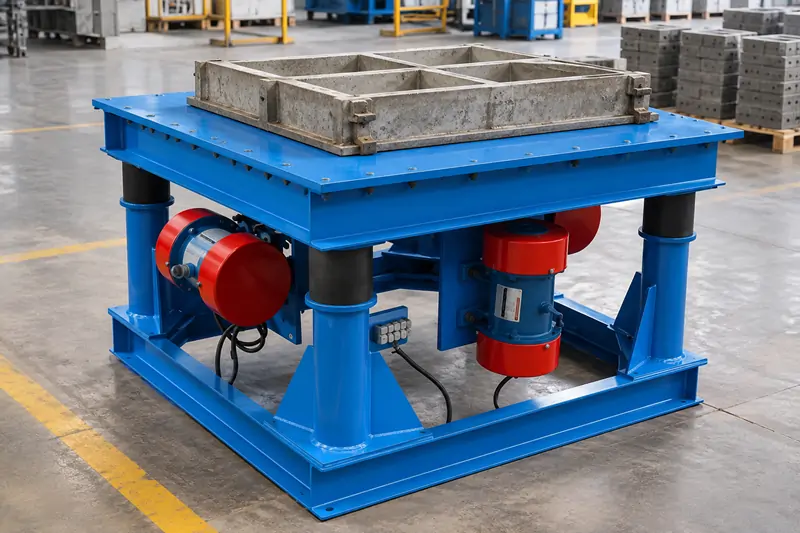
A vibrating table sits at the end of a filling process and shakes a filled container so the product inside settles. The fill level drops as trapped air escapes. That changes how much product fits each carton, drum or bulk bag, and it can change what the freight carrier charges to move it. Budgeting for one means pricing the machine and its running costs against any shipping savings it may produce in one calculation.
What the table does and how to frame its cost
In industrial packaging, this process is called bulk material densification. Powders, granules, flakes and pellets trap air as they fall into a container, and a filled carton can hold a large share of empty space between particles. Controlled vibration lets the particles rearrange into a tighter packing pattern. The fill line drops, and the container gains usable capacity.
Settling the same amount of product in the same container leaves more empty space above it, and that extra headspace has two practical uses. A line can put more product into the same container, or it can switch to a smaller container for the same product weight. Only the second changes what the package measures. It can lower freight costs where a carrier bills by dimensional weight, a method that prices the outer dimensions of a package as well as its mass, but a smaller carton may cost the same to ship when actual weight sets the charge.
These tables serve operations filling cartons, pails, steel drums, Gaylord containers and FIBC bulk bags with products that settle: food ingredients, chemicals, minerals, plastic resins. A liquid filler does not need one. A plant packing low-density powder into drums usually does.
Procurement teams often class a compaction table as a minor accessory, priced like a spare conveyor section. That framing produces underpowered purchases, because the cheapest deck on the quote sheet can carry the highest running costs on the line. A budget based on total cost of ownership, or TCO, covers purchase price, installation, energy consumption and maintenance across a working life, using the supplier’s expected service life for the specified duty.
TCO also counts the money the machine saves. A table that makes a smaller package possible can reduce freight spend, depending on the packaging change and the carrier’s rates. A table sized wrong for the cycle rate becomes a bottleneck that consumes labor hours. The budget has two sides: what the table costs to buy and run, and what it returns in freight and labor.
Load, deck size and steel decide the base price
The first pricing variable is the maximum static load: the heaviest filled container the deck must carry and shake. A table built for hand-loaded cartons uses lighter steel and smaller vibrators than one built for a filled bulk bag. Suppliers apply a dynamic load factor on top, because the deck has to accelerate the container’s mass as well as hold it.
Deck dimensions follow the container footprint. A drum line needs a smaller deck than a Gaylord station, and a bulk bag frame needs surface area plus enough stroke, the vertical travel of the deck, to move a tall flexible container. Structural reinforcement, conveyor-matched mounting height, container fixturing and any guarding each move the fabrication quote.
Force output can be easy to miss. Free-flowing granules settle with modest amplitude. Fine aerated powders need longer cycles or higher G-force to release their trapped air. A table undersized on force stretches every cycle, and the packaging line paces itself to the slowest station.
Most suppliers carry standard deck sizes for common containers. Many also build custom-engineered industrial vibrating tables for lines where container size or conveyor layout falls outside catalog limits. Custom work adds engineering hours and fabrication time to the quote, and it adds capability beyond the standard catalog, such as integrated load cells or clearance for bag frames.
Drive selection sets the utility bill
Two drive types power most industrial tables. Rotary electric vibrators are motor-driven units with eccentric weights, built for continuous duty and high amplitude. Pneumatic ball and piston vibrators run on compressed air, and they often carry a lower purchase price.
Running costs reverse that order. Compressed air is among the most expensive utilities in a plant. The compressor burns electricity well away from the point of use, and a pneumatic vibrator draws air for every second it runs. A rotary electric unit draws a modest electrical load at the deck and holds its force output steady across long cycles.
Electric drives can also pair with variable frequency drives, or VFDs. These let the controls tune motor speed and the resulting G-force to each product. A fragile flake needs gentler force than a dense mineral granule, and a VFD lets one table handle both. The VFD adds cost to the control panel, and it returns that cost in changeover time when one table serves several products.
Pneumatic units still suit hazardous or wet areas where an electric motor would need costly protection, provided they are assessed and selected for that environment. If a plant already has compressed air at the line, connection cost is low, and the difference appears on the utility bill.
Environment and build specification move the quote
A standard table ships in powder-coated mild steel, which suits dry, non-corrosive products. Food and pharmaceutical packagers usually need stainless steel, in 304 grade for general washdown duty or 316 where chlorides and caustic cleaners attack the surface. Stainless fabrication raises material and labor costs on the base build.
Washdown duty adds more than metal. A table hosed down every shift needs sealed bearings, sloped surfaces that shed water, stainless fasteners and a washdown rating such as IP66 or IP69K on motors and enclosures. Chemical plants may need explosion-proof motors. Each protection grade narrows component choices and raises the quote.
Grade changes also move lead times, so the build specification belongs in the project schedule as well as the quote. Specifying the environment at the RFQ stage prevents paying to rebuild a standard table after the first failed inspection.
Standalone stations versus in-line automation
A standalone station is the simplest setup. An operator rolls or lowers a container onto the deck, runs a timed cycle and removes it. The machine cost stays low, and the labor cost stays with the operator, who handles every container twice.
An in-line system builds the table into the conveyor. Roller conveyor integration lets containers index onto the deck, and pop-up rollers or a lowering deck transfer them without manual lifting. Pneumatic deck clamps hold the container during the cycle, and a PLC sequences the fill, weigh, settle and discharge steps automatically.
The most automated versions add tare-and-gross weighing. Load cells under the deck weigh the container empty and full, so the line fills and compacts to a target weight in one station. Combining both steps in one footprint removes a conveyor transfer and the second operator position that tends to come with it.
Each layer of automation raises the capital figure and cuts the labor minutes per container. High-volume plants recover that spend fastest, and low-volume lines often stay manual by choice.
Isolation protects the floor and nearby equipment
A vibrating deck has to shake the container while the frame and the floor stay still. Isolation mounts, either elastomer pads or air springs, sit between the deck and its frame and absorb the force that would pass into the concrete slab. Isolation hardware is a small share of the purchase price, and it is one of the first places a low-cost builder trims the specification.
Under-specified isolation is where a budget table generates unbudgeted costs. Vibration transmitted into the floor can crack slabs over time. It also travels into nearby machinery, where sensitive equipment such as an inline checkweigher loses accuracy and wears early. Replacing isolators on a schedule costs little, and the supplier can state that schedule before purchase. Repairing a floor or recalibrating a weigh station repeatedly costs far more.
Where the payback comes from
Freight savings can lead the payback case where the packaging itself changes. Product trials can establish whether settling changes the package volume needed. If trials support smaller cartons, more units may fit on each pallet, which brings dimensional weight penalties down across outbound loads.
The saving compounds in the warehouse, because smaller cartons raise pallet density and reduce the storage cube each unit occupies. The math can start with a single test container: measure the fill-line drop and convert it to package volume, then apply the carrier’s DIM factor to the smaller dimensions. The result is a per-package saving that multiplies across annual ship volume.
Labor savings run alongside. Manual settling, where an operator tamps or shakes each carton, or overfills it and skims it back, adds seconds to every cycle and strain to every shift. Removing that step shortens the cycle time per container and reduces the repetitive-motion exposure behind musculoskeletal injury claims. Timing the manual step and pricing those hours at the loaded labor rate completes the labor half of the payback case.
Maintenance and the request for quote
A five-to-ten-year budget carries small recurring line items. Isolators wear and need replacement on a cycle the supplier can state in advance. Rotary vibrator motors need re-greasing at set intervals. Pneumatic units add their own consumable: clean, dry air, and service life drops without it.
Keeping a spare vibrator motor and a set of isolators on the shelf can turn a multi-day stoppage into a short one. The cost of those spares is minor next to a stalled packaging line.
The request for quote determines the quality of every number that follows it. Give the supplier the container types and filled weights, the deck footprint and conveyor height, the target cycle rate and the control scope, from a simple timer to VFD tuning with PLC integration. State the environment, washdown or hazardous, and ask for commissioning: installation checks, force tuning on actual product, cycle verification and operator training.
Quotes built on that scope can be compared line by line. The lowest number on the page stops being the automatic choice, because the machine has to fit the line, the utility bill, the labor budget and the freight case.